Showing posts with label Recipes. Show all posts

Thursday, 9 July 2009

Bulls' heart steaks "Margherita"

We've been buying Coeur de Boeuf (Bull's heart) tomatoes at the farmers' market in Velleron.  They are aptly named - heart shaped and enormous, and you can cook hem like meat.  They're sweet and flavourful and their flesh is so firm that they can be sliced and grilled on the barbecue.

The other night, we cooked them in just that way and then tossed torn fresh mozzarella and basil leaves over them and finished with some good olive oil and balsamic vinegar.  Delicious! 
 The combination of tomato, mozzarella and basil is called 'Margherita' after the classic pizza topping named Margherita after the queen of Italy, because of its red, white and green colouring; the colours of the Italien flag.  

Saturday, 18 April 2009

Jerusalem Artichoke and Carrot Soup


Debbie made the soup, I Polloked it up!

Here's a soup that our friend Debbie made. It's simple but delicious...

1 onion chopped and fried in olive oil. Then add equal amounts of peeled and diced carrots and Jerusalem artichokes, fry a little more and then cover with water and boil until the veg is soft and mushable, then mush it. Add more water to gain your preferred viscocity, bring back to the boil, and serve.

I added drizzles of pistachio oil, to bring out the nuttiness of the Jerusalem artichokes, a little cream, to add a little richness, and a good grind of black pepper, for spice. It all looked very Jackson Pollock.

Jerusalem artichokes are called topinambours in France. They have a bit of a reputation as poor people's food here, as it was all that was available abundantly during the winter months of the war, so older people tend to shun them. They also have a reputation for causing flatulence! (Although we've never noticed the effect.) So another name for this picture is "Art for Fart's Sake"!

Thursday, 27 March 2008

Birthday Parcels, good enough to eat!

Last night we cooked a meal to celebrate one of our guest Fiona's 21st birthday. We cooked:

Twice baked parmesan soufflées

Filo parcels of chicken, sun-dried tomatoes, mushrooms and thyme

Raspberry Pavlova

Everything was greated with reassuring oooohs, (especially the Pavlova, which was getting on for half a metre in diameter!) and all was polished off to everybody's delight.

The filo parcels are fun to make.

For each parcel you'll need to pieces of flattened out chicken breast about 8-10cm across. Flatten chicken breasts buy spreading them on a solid board, laying a piece of cling film over the top of them, and then bashing them flat with a meat mallet (or similar club-like implement such as a wooden rolling pin). Then cut them into 2 or 3 suitably sized pieces depending on the original size of the fillet and the size to which it bashes out.

The chicken breasts need to be part-cooked before being baked in the parcels as filo pastry cooks very quickly. I poached them (to keep the chicken good and moist) in a broth of water, rosé wine - white would work just as well, a large, smashed clove of garlic, a good hand-full of fresh sage leaves, four bay leaves and salt. I brought the broth to the boil and then switched it off, allowing it to steep while I bashed out the chicken breasts.

When I was ready to go, I brought the broth back to the boil and then placed half a dozen chicken pieces at a time into it and put a lid over the pan. It took a minute or two for the broth to come back to the boil, by which time the chicken was poached through. So I fished out the chicken and repeated the process with the remaining batches until all my chicken bits were poached.

All of this, I did earlier in the day. I put all the chicken pieces in a pyrex bowl and, once it had cooled, covered them with the strained broth to keep them moist and to put maximum flavour into the chicken.

At the same time as preparing the chicken, I also prepared the tomato stuffing that completed the parcels. I fried finely chopped onions, with roughly chopped sun-dried tomatoes and mushrooms, a good bunch of time leaves and salt an pepper. As the mix softened and started to catch, I loosened the mixture with a glug of balsamic vinegar followed by a generous couple of glasses of wine. This continued to cook until all the liquid was absorbed, but the mixture remained moist. This, again, was then placed in a bowl and covered ready for later.

Variations which we might try in the future - using black olives instead of mushrooms, swapping thyme for fennel seeds, including roughly crumbled feta cheese (a good veggie version too?)

Fiona's a vegetarian, so a veggie version was prepared for her. In a heavy-bottomed pan, I dry fried a tablespoonful of pine nuts. To them, I then added around half a cupful of the tomato stuffing mix and a splash of water (as the pan was very hot and I didn't want the mix to stick). I then stirred in a tablespoonful of arborio rice and let the mix cook a little. I then added a little water and stirred it in, allowed the mix to boil until all the liquid was absorbed and then repeatedly added a little more water and boiled until absorbed, until the rice was soft. Effectively, I made a risotto without much rice in it. This too was made in advance.

In the evening, the oven went on at about 7 (the twice baked soufflées needed to go in for their second baking too) at around 180º. It then took about 40 minutes to make ten parcels. For each, you need two sheets of filo, cut in half. The first filo sheet is laid on a clean surface in roughly brushed with a little melted bitter, the second then laid at a right angle over the first. Again brush with melted butter and repeat for layers 3 and 4, this time laid diagonally to the first two layers. In the centre of this filo flower, place a chicken piece followed by a spoonful of tomato stuffing as a kind of sandwich filling, and then complete the sandwich with another piece of chicken.

Then brush a little more butter around the exposed filo and draw it up to envelope the chicken/tomato filling. Scrunch it together in a kind of rough 'bunch' at the top of the parcel. Brush on a little more butter (this sounds like a lot of butter, but it's really only smeared on) and then place on a well greased baking sheet.

Cook for between 20 and 30 minutes until the pastry is crisp and golden.

I cooked a little extra stuffing (enough for about another tablespoon each). To this I added a tin of tomatoes that I first blitzed in the food processor. I then heated this through to make a sauce to accompany the parcels, which were also served with broccoli, green beans and chive mashed potatoes.

Saturday, 30 June 2007

Last Night's Dinner - Saturday 30 June

We're cooking dinner every night this week. I thought I'd share this one...

Leek feuillettés

followed by

Chicken breasts stuffed with lemon and sultanas, wrapped in jambon cru with green beans and new potatoes and a yoghurt, lemon juice and olive oil dressing

followed by

Chocolate and orange mousse

Chicken Breasts stuffed with Lemon and Sultanas, wrapped in Jambon Cru Serves 6

1 onion
2 lemons
6 bay leaves
A handful of sultanas
3 slices of stale bread
6 chicken breast fillets
6 large slices of jambon cru (parma ham or similar)
Salt, pepper, olive oil

Preheat oven to 200ºC

Chop the onion to sultana sized pieces. Finely slice the rind (not the pith) of the 2 lemons and fry with the onion, bay leaves, and a pinch of salt until soft. Then add the sultanas, a good grind of pepper - enough to make the finished stuffing properly peppery - and squeeze in the juice of one lemon and continue to cook until the liquid is reduced. Finish by removing from the heat, taking out the bay leaves and stirring in the juice of the other lemon and the bread crumbs.

Bash out the chicken breasts until flat and about double in size (cover with cling film as you do this to stop the fillets breaking up). Spread the fillet out on its back and pat a sixth of the stuffing into its centre. Roll it and then roll it again in a piece of jambon cru to hold it together.

Cook for 20/25 minutes.

Wednesday, 6 June 2007

Burn, Baby, Burn - It's a Barby Inferno!

(Apologies to fans of The Tramps)

I have mentioned that it was my mum's birthday the other week. My dad just sent me this picture of me barbecuing for the family... (That's my concerned looking mother, left, and aunt in the background.)

[My first tip for BBQing is get the coals well lit in advance so that they have died down to an intense glow without any flames.]


Well - those greasy Spanish sausages soon put an end to my BBQ best practice demonstration. They were good though - a kind of chorizo with a mild aniseed flavour.

Here are a couple of favourite barbecue accompaniments:

White Bean, Orange and Bacon Salad (Serves 6 approximately)

Open a large tin or jar of haricot beans (experience shows that the ones in jars tend to be better quality - larger and less mushy) - drain and rinse the beans and allow them to drain.

Fry a finely chopped onion with a handful of lardons (bacon cubes) and the grated zest of an orange. Allow the onion to brown slightly and the bacon to crisp a little around the edges.

Then chuck in a about half a cup of chopped fresh sage and squeeze in the orange's juice. Turn the heat to high for a few seconds and let the orange juice de-glaze the pan and the sage to wilt but not cook. Then turn the heat off.

Toss the beans with the orange/bacon bits, dress with a drizzle of olive oil and taste - season accordingly and add white wine or cider vinegar or lemon juice if you think the salad needs a little edge.

Variation

Try white beans, onion, rosemary and lemon. Or the same with flageolet beans.

Rosemary Potatoes


(Great with old or new potatoes)

Clean but do not peal sufficient potatoes for the number of guests expected then add a few more as these are very more-ish. If they're small (egg-sived), reckonn on 2-3 halves each. If their bigger then you can reduce the quantity accordingly.

Halve the potatoes longways (make a mental note of the quantity). Put them in a bowl, add a spoonful or two of water, cover them with cling film and microwave for a few minutes until they start to soften. (If you are preparing quite a few, they may need to be redistributed in the bowl to ensure even cooking, but take care at this time not to break the spuds as they need to keep their form. Note - We find that the microwave damages the potatoes less than boiling.)

While the potatoes are par-boiling in the microwave, nip out to the garden and pick a rosemary tip for each potato half - each a couple of centimetres long for little spuds, a little longer for bigger ones.

When the spuds are soft to a sharp knife, drain them. Oil a baking tray with a drizzle of olive oil.

Place a rosemary tip on the baking tray and put a potato half, cut-side down on top of the rosemary. Repeat for the other potato halves. Drizzle (or brush) their backs with a little more oil.

When the barbecue is going - hot coals, flames died down (see above) - before cooking the meat, put the tray of potatoes on the barbecue to cook. After 5 minutes, check the potatoes - as they cook, they press the rosemary flat onto their faces. When they are nicely golden, browned around the edges and the rosemary is good and flat (it'll turn very dark - almost black), remove them from the heat. If you are doing a lot, then do the next batch at this point. To finish the potatoes put them skin side down directly onto the barbecue grill, to cook their skin and get that char-grilled stripey effect. You can do this while cooking the meat, or beforehand if you think they'll get torched by the Spanish sausage inferno! If so keep them wrapped in foil to keep them warm.

Serve them face up on a platter with a sprinkling of coarse sea salt.

[I'll try to remeber to photograph these recipes next time we do them.]

Sunday, 27 May 2007

Primevera


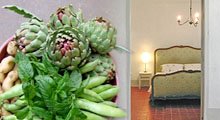
My haul from the garden last night - artichokes, broad beans, the first handful of new potatoes and a bunch of mint.

The potatoes were a trial lifting to see if our drought ravaged potatoes are looking as sad beneath the ground as above it. Fortunately the answer seems to be know, but I'll leave them a few more weeks to develop now that the watering system on the potager is functioning again.

The rest went into a pasta 'Primevera' along with other fresh veg bought at the farmer's market in Velleron the other day.

Pasta Primevera

For six of us...

A desert bowl each of shelled broad beans, fresh peas, and small courgettes about 10cm long and cut into 2cm slices
6 artichoke hearts, trimmed and de-choked
A good handful of fresh mint
5/600g Pasta - Orecchiette preferably
Olive oil
Nut oil
White wine
A lemon
Lemon juice
Salt

To serve - coarse sea salt, ground black pepper, Parmesan

Start with the artichokes - I'm not going to tell you how to prepare them because there are loads of descriptions for this process already to be found on the internet. Try this one from Sam Breach's Becks & Posh (rhyming slang for nosh) blog. The secret really is lemon juice. When you've prepared one artichoke heart, chuck it into a bowl of water laced with a good squeeze of lemon juice to stop it discolouring.

For this recipe, cut the artichoke hearts vertically into quarters. Boil them for 5/10 minutes until they are soft enough to pierce easily with a sharp knife. The ideal finish is to blacken them slightly on a barbecue or grill pan, but if this isn't an option, fry them 'til they crisp up slightly in the oil about to be used for the courgettes.

So your artichokes are ready. Your beans and peas and courgettes are all prepared. It doesn't take long to bring the whole thing together now, so it's time to put the pasta on. Bring a large pan of water to the boil, salt it generously and pour a good glug of olive oil onto the surface. Chuck in the pasta and cook it at a rolling boil until 'al dente' (soft but still chewy, not reduced to a pulp!).

While the pasta is cooking, the broad beans and peas will also need a quick boil (you can use the water you just boiled the artichokes in). 5 minutes should be the maximum if the broad beans are young and delicate as ours were last night. If they're a bit older and tougher, let the beans have a 5 minute start over the peas.

(A note about peas - fresh ones really are better than frozen in this case. Their texture is so much better than the soft, frozen ones.)

As the pasta, beans and peas boil, fry the courgettes in a shallow pan on a high heat in olive oil with a dash of nut oil added and a sprinkling of salt to draw out their flavour. For a little extra 'zing' try adding the grated rind of the lemon too. When they are a little browned and crisped, chuck a slug of white wine into the pan to deglaze any pan juices and boil it off, before tossing in the artichoke hearts for a quick final heat through.

About this time, the pasta should be cooked, as too the beans/peas. Toss the drained beans and peas in with the courgettes and artichokes. Drain the pasta and return it to its cooking pan along with the vegetables. Toss them all together.

Pull the mint from its stems and chop it roughly. Then as you spoon the pasta into a suitably beautiful serving bowl with a slotted spoon, sprinkle chopped mint into the mix as you go. This avoids tossing the pasta in the serving bowl, which always seems to result in the pasta rising to the top and the vegetables sinking to the bottom.

Finally dress with a drizzle of good quality olive oil and the juice of the lemon and serve with crunchy rock salt, coarse ground black pepper for those who require further seasoning and Parmesan cheese from which your guests can cut shavings with a potato peeler.

Alternatives

Try adding asparagus tips or/and green beans. Try it later in the summer with roasted cherry tomatoes, toasted pine nuts and basil - we will and I'll share the results here.